February 13, 2026
For this year's design challenge, “Farm-to-Table,” the students were asked to consider the environmental and social costs of modern food systems and to design cities that apply circular economy principles that keep products and materials in circulation through maintenance, reuse, recycling, and other methods.
The 2026 Philadelphia Future City Competition, held on January 24 at Archbishop Carroll High School in Radnor, PA, featured work from approximately 45 middle school teams. Despite chilly temperatures and forecasts of a blizzard, students, teachers, and families enthusiastically trekked to the competition to showcase their work. The teams shared creative city design models and delivered presentations. The atmosphere was electric and full of inspiring ideas.
For this year's design challenge, “Farm-to-Table,” the students were asked to consider the environmental and social costs of modern food systems and to design cities that apply circular economy principles that keep products and materials in circulation through maintenance, reuse, recycling, and other methods. They proposed innovative solutions to reduce food waste, conserve water and energy, and reduce emissions. Teams were evaluated and given awards by a panel of judges. DVRPC had the honor of sponsoring an award for a team that showcased regional planning ideals.
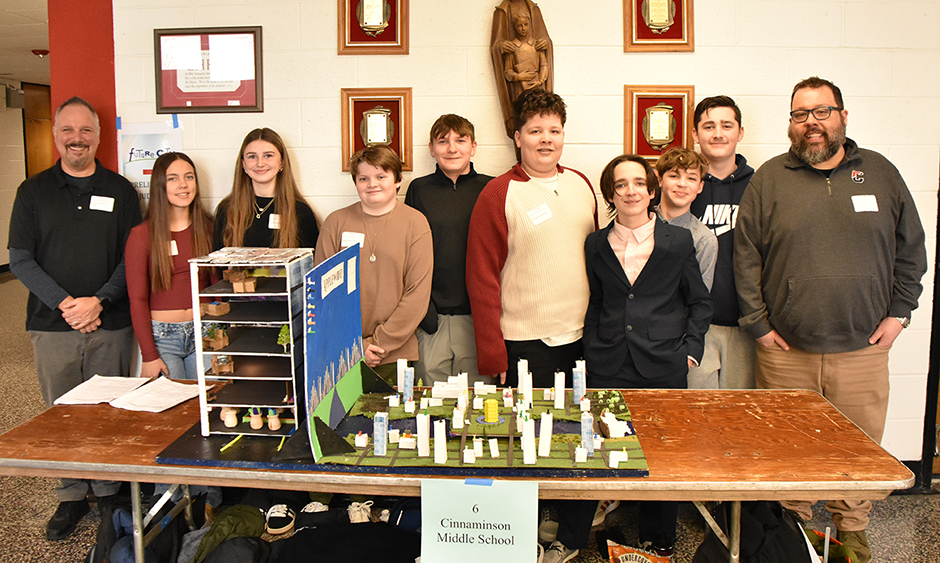
DVRPC’s Award for Excellence in Regional Planning was presented to Cinnaminson Middle School for their proposed city, Applewood, located in a fictional version of Tasmania. Applewood stood out for its high-quality and thoughtful city design. The Cinnaminson team created a circular economy for Applewood by employing hydroponics, AI, biofuel generation, and other methods to eliminate food waste. Applewood uses multi-level farm hubs that employ hydroponics and AI to grow produce and convert waste into nutrient-rich soil. Additionally, they transform agricultural byproducts like apple and cherry waste into biofuel, and salmon hides into usable textiles.
The city's infrastructure is also high-tech and hydropower-based. It includes supersonic trains and a "mushroom money" incentive system for residents who help “close the loop.” It was also one of the few cities in the competition with clearly defined and thoughtful land-use planning. By being able to think comprehensively and balance the needs of community, environmental, transportation, and economic systems, this team reflected a great understanding of the many facets of regional planning. As the winners of the Excellence in Regional Planning award, Cinnaminson Middle School will attend a Regional Technical Committee meeting later this spring to present their work.